 Plastiki is a boat that was made with 12,500 recycled bottles. This boat is 20 meters long, and this idea was made by one of the 6 crews, David de Rothchild. He's going to sail all over the Pacific Ocean, starting from California, USA and finally going to reach Sydney in Australia. Some people think that it is not possible to sail from California to Sydney just by a boat that is made by plastic bottles, but the crews all think that they are going to make it. It started sailing from March 20, 2010 which was 10 days ago, and it is now passing Cape Horn, the bottom part of South America. This expedition started because of the amount of air pollution and global warming. David de Rothchild said that the Pacific Ocean is just one big chunk of trash and the he decided to cross the Pacific Ocean by boats made by 12,500 recycled bottles.
Showing posts with label Social Studies. Show all posts
Showing posts with label Social Studies. Show all posts
Tuesday, March 30, 2010
Plastiki
Plastiki is a boat that was made with 12,500 recycled bottles. This boat is 20 meters long, and this idea was made by one of the 6 crews, David de Rothchild. He's going to sail all over the Pacific Ocean, starting from California, USA and finally going to reach Sydney in Australia. Some people think that it is not possible to sail from California to Sydney just by a boat that is made by plastic bottles, but the crews all think that they are going to make it. It started sailing from March 20, 2010 which was 10 days ago, and it is now passing Cape Horn, the bottom part of South America. This expedition started because of the amount of air pollution and global warming. David de Rothchild said that the Pacific Ocean is just one big chunk of trash and the he decided to cross the Pacific Ocean by boats made by 12,500 recycled bottles.


Tuesday, January 26, 2010
10 Historical Data of Haiti
1. On 1942, Christopher Colombus landed on Haiti's north coast and claimed the country as the island of Spain.
2. The French took over this colony in the 1960s and increased production in crops like coffee, cotton, and sugarcane.
3. There was a French Rebellion from 1791- 1803. The Jamaican-born person started this and fought a lot of French people including Napoleon's army. This war lasted for 13 years.
4. A Civil War happened on the country in 1807 and was devided into North and South. Jean-Pierre Boyer reunifies the country and became a president on 1820.
5. The tropical climate and trade winds produce warm temperatures throughout the year. Haiti has a lot of mountains and produces coconuts.
6. The people in the North Haiti have a Creole accent. The population is 95% black and 5% white.
7. Carnival and New Year's Day are the biggest holidays in the whole year for most Haitians.
8. About two-thirds of the Haitians live with farming and they even have a small farm. Unluckily, for lots of times, frequent storms destroy the farms and crops.
9. Haiti produces coffee, mangoes, sugarcane, rice, corn, sorghum, and wood.
10. The president in Haiti is elected every 5 years and Haiti is the poorest country in the Western Hemisphere with 80% living in poverty.
2. The French took over this colony in the 1960s and increased production in crops like coffee, cotton, and sugarcane.
3. There was a French Rebellion from 1791- 1803. The Jamaican-born person started this and fought a lot of French people including Napoleon's army. This war lasted for 13 years.
4. A Civil War happened on the country in 1807 and was devided into North and South. Jean-Pierre Boyer reunifies the country and became a president on 1820.
5. The tropical climate and trade winds produce warm temperatures throughout the year. Haiti has a lot of mountains and produces coconuts.
6. The people in the North Haiti have a Creole accent. The population is 95% black and 5% white.
7. Carnival and New Year's Day are the biggest holidays in the whole year for most Haitians.
8. About two-thirds of the Haitians live with farming and they even have a small farm. Unluckily, for lots of times, frequent storms destroy the farms and crops.
9. Haiti produces coffee, mangoes, sugarcane, rice, corn, sorghum, and wood.
10. The president in Haiti is elected every 5 years and Haiti is the poorest country in the Western Hemisphere with 80% living in poverty.
Monday, January 18, 2010
Haiti Earthquake Part II
 Last Tuesday about at 5:00 p.m., there was a disastorous earthquake at magnitude 7.0 that struck Haiti. It was a total disaster and a nightmare. However a lot of things changed after 1 week.
Compared to last week, there are lots and lots of supplies coming from different countries. They are all sending waters, food, aids, medical supplies and lots more. Countries all over the world send these supplies by airplanes and trucks. The picture above is another country coming to Haiti with all the supplies. For example, Brazil sent about $10000000 to Haiti and Korea sent about $10000000 as well to Haiti. As I said, lots of countries are helping Haiti such as U.S.A., China, Iceland, Japan, and more. There are lots of way to help Haiti victims and there is a really cool way and it's this. SMS to 90999 and type "Haiti". Then, $10 will go to Haiti. In one day, $2000000 dollars were sent to Haiti just because of SMS's. The Haiti people collected diapers, batteries, medicines, clothings, and toiletries. U.S.A. is helping Haiti a lot by sending tons and tons of water because Haiti is most short of food and water.
This earthquake was a nightmare, and we are lucky that lots of countries are sending help to Haiti. I hope more countries still help and give supplies to Haiti.
Thursday, January 14, 2010
Haiti Earthquake
 2 days ago, on January 12th 2010 at about 5 pm, a disastorous earthquake struck Haiti, Carribean. This earthquake was a really bad earthquake with a magnitude of 7.0 on the Richter Scale. This destructive earthquake killed about 100,000 people and a lot and lot of people were injured and are still missing. Lots of children are still stuck in the collapsed building and can't come out of it. 17 UN people died and 56 people were injured while over 200 UN staff are still missing. Lots of buildings and schools collapsed during this earthquake and all the people were running all over the place to survive from the earthquake. Even the palace in Haiti collapsed and the walls were all cracked. The telephone connections didn't work as well. Haiti is one of the poorest countries in the world with only $1.5 each day to spend. They are a poor country... and they even get this destructive earthquake!!! How unlucky are they? Again, lots of people are injured and are bleeding so they need a doctor but they can't find a good doctor with only that amount of money each day. Lots of Haiti police are still trying to find missing people and people that are stuck on the buildings. 19 countries including U.S.A, China, Brazil, UK and Ireland are helping Haiti by sending aids, and more. If you were at Haiti right now, you will see dead bodies and injured people bleeding on the street.
Tuesday, November 24, 2009
GeoActive Questions (2)
Activities:
1. List the main reasons for water scarcity.
The main reasons for water scarcity is that many hot places such as deserts have very low
rainfall, variations in climate, land degradation, population growth and water pollution.
2. What is a drought? What type of hardships do you think that a drought could cause if you were living in a village in a poor country such as Ethiopia?
A drought is a period of below average precipitation. If I was living in a poor country such as
Ethiopia, the hardships I would face is fatal diseases such as cholera.
3. How does land degradation affect the supply of fresh water?
Land degradation can be caused by the excessive destruction of natural vegetation through
deforestation, overgrazing and farming. Then the soil would be not able to store water.
4. (a) What is El Nino?
El Nino is a warming that develops every three to five years in the Pacific Ocean off the coast of
Peru. During El Nino, the moist easterly trade winds that normally blow across the Pacific Ocean
reverse their direction.
(b) Why does El Nino often cause drought in Australia?
El Nino often cause drought in Australia because of the reversal of air pressure across the Pacific, resulting in high pressure systems building up over most of Australia.
5. Observe the map showing the global effects of El Nino in 1982-83.
(a) What effects does El Nino have on the availability of fresh water?
There can be period of heavy rain through the west coast of South America which would cause severe flooding. Water will be polluted and only a little bit of clean water is available.
(b) Name the countries and describe the problems that arose from decreased rainfall caused by El Nino.
Africa: Reduced corn crop in sub-Saharan region
China: Agricultural land under threat from drought in northern regions and flooding in southern regions
United States: Rainfall above normal in north-western states (double the historical averages)
Indonesia: High air pollution levels, following forest fires
Philippines: Lower rice harvest following drought
Colombia: Fishing operators affected by lower catch (down 20%)
Papua New Guinea: Drought-related failure of food crops, leading to famine conditions requiring food aid
Australia: Wheat exports threatened by drought conditions across grain-growing areas, particularly New South Wales
Peru: 1. Flooding (also in Chile) 2. Fishing operators affefcted by lower catch as anchovy and Pacific sardine move offshore to escape warm currents (5 degrees C above normal temperatures)
1. List the main reasons for water scarcity.
The main reasons for water scarcity is that many hot places such as deserts have very low
rainfall, variations in climate, land degradation, population growth and water pollution.
2. What is a drought? What type of hardships do you think that a drought could cause if you were living in a village in a poor country such as Ethiopia?
A drought is a period of below average precipitation. If I was living in a poor country such as
Ethiopia, the hardships I would face is fatal diseases such as cholera.
3. How does land degradation affect the supply of fresh water?
Land degradation can be caused by the excessive destruction of natural vegetation through
deforestation, overgrazing and farming. Then the soil would be not able to store water.
4. (a) What is El Nino?
El Nino is a warming that develops every three to five years in the Pacific Ocean off the coast of
Peru. During El Nino, the moist easterly trade winds that normally blow across the Pacific Ocean
reverse their direction.
(b) Why does El Nino often cause drought in Australia?
El Nino often cause drought in Australia because of the reversal of air pressure across the Pacific, resulting in high pressure systems building up over most of Australia.
5. Observe the map showing the global effects of El Nino in 1982-83.
(a) What effects does El Nino have on the availability of fresh water?
There can be period of heavy rain through the west coast of South America which would cause severe flooding. Water will be polluted and only a little bit of clean water is available.
(b) Name the countries and describe the problems that arose from decreased rainfall caused by El Nino.
Africa: Reduced corn crop in sub-Saharan region
China: Agricultural land under threat from drought in northern regions and flooding in southern regions
United States: Rainfall above normal in north-western states (double the historical averages)
Indonesia: High air pollution levels, following forest fires
Philippines: Lower rice harvest following drought
Colombia: Fishing operators affected by lower catch (down 20%)
Papua New Guinea: Drought-related failure of food crops, leading to famine conditions requiring food aid
Australia: Wheat exports threatened by drought conditions across grain-growing areas, particularly New South Wales
Peru: 1. Flooding (also in Chile) 2. Fishing operators affefcted by lower catch as anchovy and Pacific sardine move offshore to escape warm currents (5 degrees C above normal temperatures)
Tuesday, November 10, 2009
GeoActive Questions
Activities:
1) What percentage of the world's supply of water is fresh water?
Answer: 2.5% of waters surface is fresh water.
2) Where is the world's supply of fresh water found?
Answer: 2% is in the form of ice on land, 0.49% is found in groundwater and the soil, and 0.01% is found in the atmosphere, rivers and lakes.
3) Even though the supply of fresh water is abundant it is still a problem. Why?
Answer: It is a problem because water and people are unevenly distributed. Because of this uneven distribution, some places and people have available and consume far more water than others.
4) Observe the map of world average annual precipitation (opposite).
(a) Describe the changes in rainfall that occur as you move from the southern to the northern tip of Africa.
Answer: From the southern tip to the northern tip, the rainfall raises until the Tropic of Cancer.
(b) Describe the changes in rainfall that occur as you move from the western to the eastern tip of Australia along the Tropic of Capricorn.
Answer: From the western tip of Australia to the eastern tip of Australia, the rainfall started out with 250mm and at the tip of Australia, it raised again until 2000mm.
5) Observe the map above of water availability per person.
(a) Which parts of the world appear to have a large amount of water available per person?
Answer: South America seems to have a high water availability per person.
(b) Which parts of the world appear to have a small amount of water per person?
Answer: Europe seems to have a low water availability per person.
6) Observe the diagram of water use.
(a) What are the main uses of water?
Answer: The main uses of water is for agriculturing.
(b) Which uses have increased the most over the last century?
Answer: Reservoir uses from evaporation and seepage has increased the most over the last century.
Saturday, October 31, 2009
4 graphics for water unit
 Here are the 4 graphics for water unit:
1. Evaporation - The picture on the right is a diagram showing how evaporation works. Evaporation is a process where water molecules change from liquid into gas, because of its increased tempreture.
 2. Condensation - The picture on the right is a diagram of condensation on a glass cup. Condensation is a process where water molecules change from gas to liquid; which is the opposite of evaporation. On the diagram, water droplets come on the surface of the glass cup, because the warm water vapor touched a cold surface.
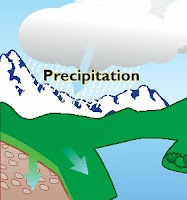 3. Precipitation - The picture on the right is a diagram showing a precipitation occuring when the rain is falling down. Precipitation is any form of water that falls to earth.
 4. Infiltration - The picture on the right is a diagram which shows the process of infiltration. Infiltration is the process by which water on the ground surface enters the soil.
Thursday, September 3, 2009
Earthquake in Indonesia

 Since Indonesia is in the Ring of Fire, Indonesia usuallly gets lots of earthquakes. This earthquake occured on September 2nd, 2009 and the earthquake measured 7.4 on the Richter Scale.
This was my 3rd situation in the earthquake but I think this one was the strongest and the most dangerous earthquake. About 80? people got killed and a lot of people were missing. There were some roads cracked and some buildings falling down and getting damaged by this earthquake.The earthquake yesterday was 40km of the coast of Jasikmalaya. There were tsnami warnings in the radio because the earthquake occured from the sea.
At our school, there was a fairly large snake on the dining table. It came out of the hole because snakes can predict that the earthquake is going to occur. However, humans don't have the sense of predicting natural disasters so we can't do anything before the earthquake occurs.
Wednesday, August 19, 2009
Typhoon Morokat
 When it rains a lot on the mountain, water will be soaked inside the mud and it will cause the seperation under the mountain. Luckily, Indonesia won't get any Typhoons because this country is near the equator. Also, mudslides would rarely happen in Indonesia because the land is flat.
 For 3 days, heavy rain struck the land of Taiwan continously. With those continuous rain, it caused a dangerous typhoon called Typhoon Morokat. This Typhoon killed about 500 people and damaged lots of builidings and houses/villages. Mudslides from the mountain killed a lot of people and also the flooding or tsnami made the damage worse. Taiwan was absolutely destructed by those natural disasters.
Subscribe to:
Posts (Atom)